Grey Room

Artificial Life and the Living Dead: Pierre Huyghe’s Ecological Aesthetics and the Becoming Environmental of Computation

Jakob Schillinger

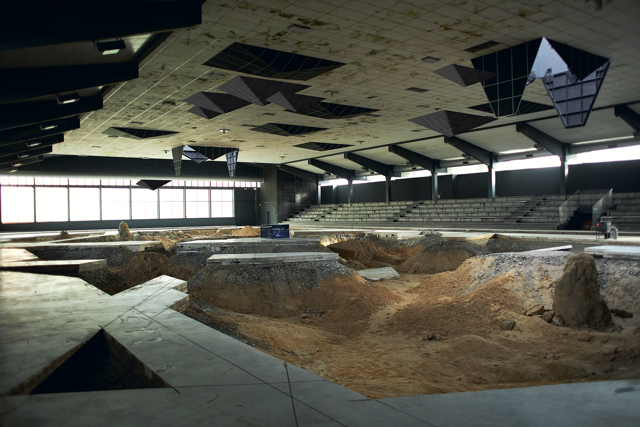
Pierre Huyghe, After ALife Ahead, 2017. Exhibition view of Skulptur Projekte Münster, Germany, 2017. Courtesy of the artist; Marian Goodman Gallery, New York; Esther Schipper, Berlin; Hauser & Wirth, London; Galerie Chantal Crousel, Paris. Photo credit: Ola Rindal © Pierre Huyghe / ADAGP, Paris / ARS, New York, 2026

Picture the universe as a gigantic computer—a literally universal Turing machine.1 Imagine life and technology were ultimately one and the same: computation.2 After ALife Ahead, Pierre Huyghe’s iconic contribution to the 2017 edition of Skulptur Projekte Münster in Germany, helps us envision such a scenario. The work articulates what Jennifer Gabrys has termed “the becoming environmental of computation”: the permeation of our physical environment with—and its administration by—embedded sensor and information technology.3 After ALife Ahead can be described as an ecosystem that comprises organic as well as technological components.4 But it goes far beyond staging mutual interactions between machinic and organic agents. As this article will show, After ALife Ahead operationally collapses world and computational models into one another. It is this deeper sense in which the work undermines traditional distinctions of nature and culture or nature and technology. To grasp what is at stake in this collapse and in Huyghe’s ecological aesthetics at large, this article examines the function of computation in After ALife Ahead.

Full PDF available for download.

Artificial Life and the Living Dead: Pierre Huyghe’s Ecological Aesthetics and the Becoming Environmental of Computation

Jakob Schillinger

Notes

  1. See Bernhard Siegert, “The Map Is the Territory—Dissolving the Barrier between Media and Nature,” Spark, 2022, 16-23: 20. Siegert formulates this thought experiment to convey the essence of the physical Church-Turing thesis, with which he associates Stephen Wolfram’s ideas about cellular automata, more about which follows below. ↩

  2. See Blaise Aguera y Arcas, What Is Intelligence? Lessons from AI About Evolution, Computing, and Minds (Cambridge, MA: MIT Press, 2025), 10,12; Benjamin Bratton, “Foreword,” in What Is Intelligence?, 7. In What Is Intelligence? Google VP/Fellow and CTO of Google’s Technology & Society Agüera y Arcas puts forth such a vision: I define life as a self-modifying, computational state of matter that arises through evolutionary selection for the ability to persist through time by actively constructing itself, whether by growing, healing, or reproducing. Yes, everything alive is a computer! … Understanding the deep role computation plays in our universe, and the way it links the seemingly disparate fields of physics, chemistry, and biology, both sheds new light on evolutionary theory and sets the stage for understanding the computational nature of intelligence. Aguera y Arcas, “What Is Intelligence?,” 10-12. In the foreword, Benjamin Bratton suggests: Are these three words—life, intelligence, technology—actually different names for the effects of a more general process? Just as life is a factory for making more life, and technology is a factory for making more technology, now life makes technologies that make new life that makes new technologies. Ultimately, it may be the same factory, and at its heart is computation. Bratton, “Foreword,” 7. ↩

  3. Jennifer Gabrys, “The Becoming Environmental of Computation: From Citizen Sensing to Planetary Computerization,” TECNOSCIENZA: Italian Journal of Science & Technology Studies8, no. 1 (2017): 1. ↩

  4. See, for example, André Rottmann’s seminal account in André Rottmann, “‘The Medium Is Leaking’: Notes on the Work of Pierre Huyghe and the ‘Ecologization’ of Contemporary Art,” Grey Room, no. 77 (2019): 77. ↩

Close